

Core insight
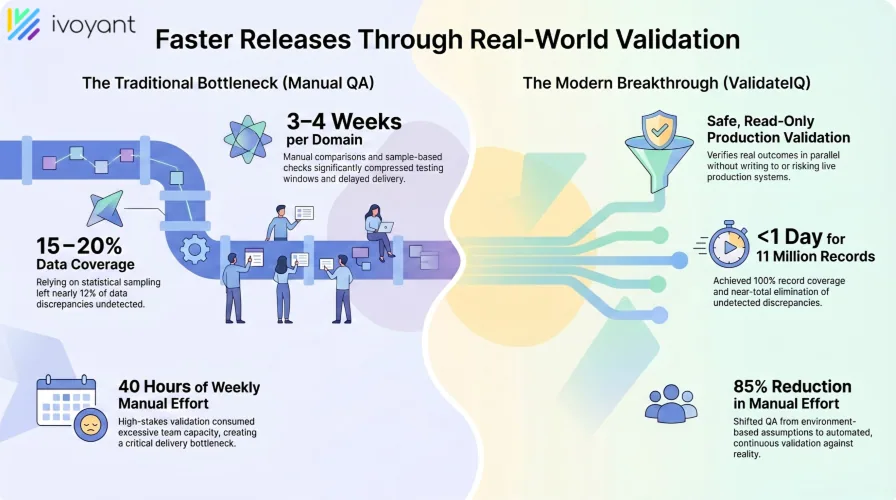
Weeks of manual testing whittled down to less than a day. This, on datasets exceeding 11 million records without risking production systems.
This is the story of how ivoyant enabled safe testing in production using ValidateIQ.
The Opening Salvo
ivoyant helped its client, a leading US-based service provider of portable storage and moving solutions, move from slow, manual, sample-based validation to a controlled production data validation model with ValidateIQ. That shift enabled faster releases, stronger data integrity, and better operational confidence.
For enterprises managing large migrations and frequent releases, QA delays are not just a testing issue. They affect delivery speed, stakeholder trust, compliance readiness, and the cost of change.
Executive Summary
The faster software moves, the less useful yesterday’s test assumptions become.
That was the reality facing the client company during a large enterprise modernization effort. Critical business data had to move accurately from legacy systems into a modern platform, at scale, and with minimal room for error. Traditional QA processes were not up to the mark. Manual checks were slow. Sampling left gaps. Pre-production validation could not fully reflect real operating conditions.
ivoyant addressed this challenge by building ValidateIQ, an enterprise data validation solution designed to verify real production data safely, at scale, and with full traceability. Instead of relying only on pre-release confidence, the client gained a controlled way to validate post-deployment truth through read-only comparison, automated checks, configurable mappings, and auditable reporting.
The outcome was clear. Validation cycles dropped and the client achieved full record coverage across datasets of more than 11 million records. Engineering teams recovered significant time, while business stakeholders gained a more reliable basis for release and migration sign-off.
Background
The client operates nationwide in a business where operational accuracy matters every day. Customer records, logistics workflows, financial data, and service processes all depend on consistent and trustworthy information. As the organization moved from legacy systems to a more modern enterprise platform, data quality became one of the most important conditions for a successful release strategy.
This was not simply a data migration problem. It was a release confidence problem. The business needed to move faster, but it could not afford to compromise stability or trust. That tension is familiar to many modern QA teams. Traditional testing can detect a lot, but it often struggles to validate what happens when transformed data meets live production conditions.
The Challenge
For the client, the issue was not simply validating data after migration. It was finding a way to release faster without accepting more risk. Traditional QA methods were proving too slow, too manual, and too limited for a migration of this scale. With huge dataset volumes across multiple business domains, manual validation could not keep pace with delivery timelines, and sample-based checks could not provide the confidence needed for sign-off.
Layered on top of this was a high-stakes modernization effort where data accuracy had a direct impact on operations, customer records, financial reporting, and stakeholder trust. The existing validation model created bottlenecks at exactly the point where release confidence mattered most.
Key challenges included:
- Unmanageable data volumes: More than 11 million records had to be validated across multiple domains, making row-by-row manual checks impractical. Teams had to depend on statistical sampling, which could not capture every discrepancy.
- Slow validation cycles: Manual comparison was taking 3 to 4 weeks per domain, compressing testing windows and putting pressure on the broader migration timeline.
- Heavy dependence on skilled teams: Validation work was consuming 30 to 40 hours a week of experienced data team capacity, turning a critical function into a delivery bottleneck.
- Gaps in defect detection: The sample-based approach was leaving an estimated 8 to 12 percent of discrepancies undetected, creating a real risk of flawed data reaching the target platform.
- No standardized validation model: Each domain was being validated in an ad hoc way, which made results inconsistent and prevented meaningful quality comparison across releases.
- Limited governance and visibility: There was no reliable audit trail showing what had been validated, when it was run, who initiated it, or what configuration was used. Reporting was inconsistent, and stakeholders lacked a clear basis for release approval.
The result was familiar to many enterprise QA teams: slower releases, lower confidence, and rising operational overhead, despite significant effort. That gap between effort and assurance is exactly what modern validation approaches are now designed to close.
Reframing the Approach
ivoyant did not solve this by simply adding more pre-production testing. It changed its approach to data testing and the validation model.
ValidateIQ introduced a safer form of testing in production. Not testing that risks live operations, but controlled validation that checks real outcomes in parallel, without writing to production systems.
Why the Shift in Approach?
- Data volumes have grown beyond what sampling-based methods generally cover
- Pre-production environments fail to reflect the realities of live environments
- Release cycles have shrunk to levels where weeks-long validation ends up disrupting desired delivery rates
- Compliance and governance demand auditability, demanding verifiable, time-stamped audit trails
This approach matters because it plugs the gap between what teams expect to happen and what often transpires after deployment.
That distinction is important. ValidateIQ does not test by breaking production. It validates production truth through read-only comparisons, controlled execution, and isolation from customer-facing workflows. In practice, that gave the client a way to move faster while reducing uncertainty, rather than increasing it.
The Solution
ivoyant developed the solution as a reusable enterprise validation framework, not a one-off utility.
At its core, the solution compares source and target datasets directly against real production-grade data. It uses a high-performance validation engine, flexible mapping logic, and queue-based execution to process large validation jobs safely and predictably. Pre-validation checks confirm that files and required columns are present before a run begins. This prevents wasted cycles and reduces avoidable failures.
The platform was built to handle more than raw record matching. It supports configurable business rules, field normalization, case-insensitive comparison, and complex transformation logic. This was essential because enterprise data rarely moves from old to new systems in a one-to-one pattern. Real validation requires understanding how the data should look after change, not just whether two files are identical.
ivoyant also made the solution accessible through a web interface where business users could select files, choose validation profiles, run comparisons, and review results without relying on engineers for every step. Dashboards, discrepancy reports, notifications, and run history created both usability and governance in the same flow.
Solution Highlights
- Real production data validation: ValidateIQ compares source and target data in live-grade environments, reducing dependence on stale or synthetic test data.
- Read-only execution: Validation happens without write operations, protecting production workflows while still verifying actual outcomes.
- Queue-based job control: Large comparison jobs are processed in an orderly way, which helps maintain system stability and predictable performance.
- Smart guardrails: Pre-validation checks catch missing files and missing columns before execution begins.
- Flexible comparison logic: JSON-driven mappings support domain-specific rules, data normalization, and transformation-aware validation.
- Audit-ready reporting: Dashboards, alerts, history, and discrepancy reports provide visibility for both technical and business stakeholders.
The Takeaways
The solution changed validation from a late-stage bottleneck into a repeatable release enabler. By moving from manual, sample-based checking to full scale, read-only validation against real production-grade data, the client gained both speed and confidence. The improvement was measurable across time, effort, coverage, reporting, and governance.
Before vs After Comparison
Metrics drawn from the ValidateIQ solution outcomes documented for the client engagement.
Beyond the numbers, three outcomes stand out:
- Faster releases with less friction: Validation that once delayed delivery by weeks could now be completed in hours, helping the client move through migration and release cycles with far less drag.
- Higher trust in production outcomes: Full coverage validation replaced sample-based assumptions with measurable proof, giving both technical teams and business stakeholders a stronger basis for sign-off.
- A more mature QA operating model: With run history, discrepancy reporting, notifications, and repeatable validation rules, the client gained a governed validation capability that can support future migrations, upgrades, and post-release checks.
This is the larger takeaway for modern QA teams. Speed does not come from reducing controls. It comes from replacing manual assurance with smarter validation built for real-world release conditions.
What Makes the Solution Different
Most QA tools are designed to improve confidence before release. ValidateIQ adds something many organizations still lack, which is confidence after deployment, based on actual production outcomes. That is the real differentiator.
It shifts QA from environment-based assumption checking to continuous validation against reality. ValidateIQ adopts a risk-free approach by validating production outcomes safely using read-only, isolated, parallel verification. In a world of large-scale migrations, complex integrations, and fast-moving release cycles, that is a more durable model.
This is also why the solution has relevance beyond one client program. The same approach can support data migration validation, bulk data loads, system integration checks, post-release sanity validation, and compliance-oriented data assurance. This highlights the solution’s reusable enterprise capability. It reflects a broader direction for enterprise QA, where speed and safety come from better validation design, not from longer release gates.
Conclusion
Modern QA teams do not ship faster by testing less. They ship faster by validating smarter.
ValidateIQ provided a practical way for the client to accelerate releases without increasing operational risk. By replacing manual, sample-based validation with controlled production data verification, ivoyant helped the client improve release confidence, strengthen data integrity, and build a more scalable quality assurance model.
The larger lesson is clear. As enterprise systems become more distributed and data-intensive, quality assurance will rely less on artificial environments and more on safe, read-only validation of real-world outcomes after deployment. That is where release confidence is heading. ValidateIQ shows what that future looks like in practice.
ivoyant has the experience and expertise to help you deliver faster and keep pace with dynamic market demands. Let’s talk.